















AI-generated image
Revier has established the first therapeutic approach to selectively target class IIa HDACs to treat cardiometabolic diseases. Our orally available small molecules are designed to inhibit the pathogenic enzymatic activity while preserving healthy biological function and avoiding canonical HDAC inhibition.
We are advancing a pipeline of novel disease modulators starting with heart failure with preserved ejection fraction (HFpEF) and atherosclerotic cardiovascular disease (ASCVD) as our initial indications. Our goal is to define a new class of treatments that directly improve cardiometabolic health and provide life-saving, long-term benefits for patients with related diseases.
Heart failure with preserved ejection fraction (HFpEF), atherosclerotic cardiovascular disease (ASCVD) and related metabolic disorders are leading causes of illness, hospitalization, and premature death for patients across the globe. HFpEF and ASCVD are complex, chronic diseases driven by interconnected biological processes such as metabolic dysfunction, inflammation, and vascular abnormalities.
Despite significant advances in cardiovascular care, many patients continue to experience persistent symptoms and serious disease burden, highlighting a need for novel treatments addressing additional disease-relevant mechanisms.
live with HFpEF worldwide, and prevalence continues to rise. Disease-modifying treatments that restore heart function and reduce mortality remain lacking, leaving patients with underlying progressive disease.
are affected by ASCVD-related conditions, including coronary artery disease and ischemic stroke, which account for nearly one-third of all global deaths.
Class IIa HDACs Represent a Novel Therapeutic Frontier
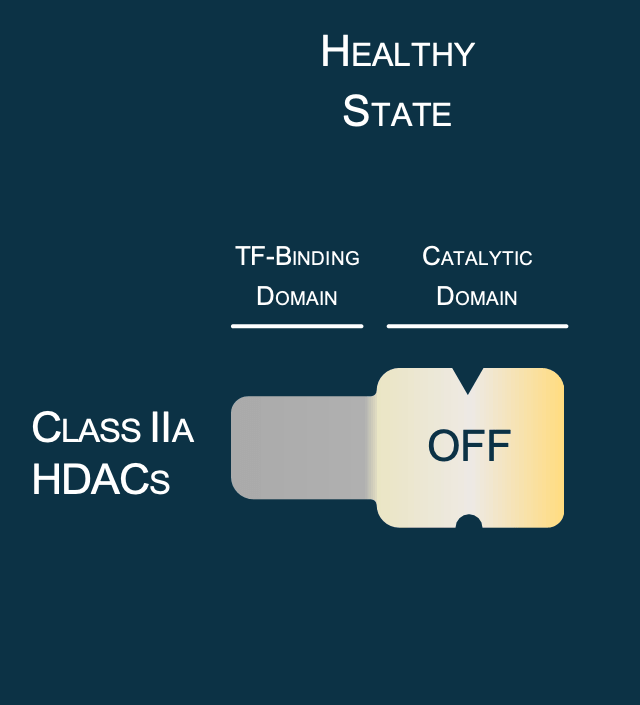
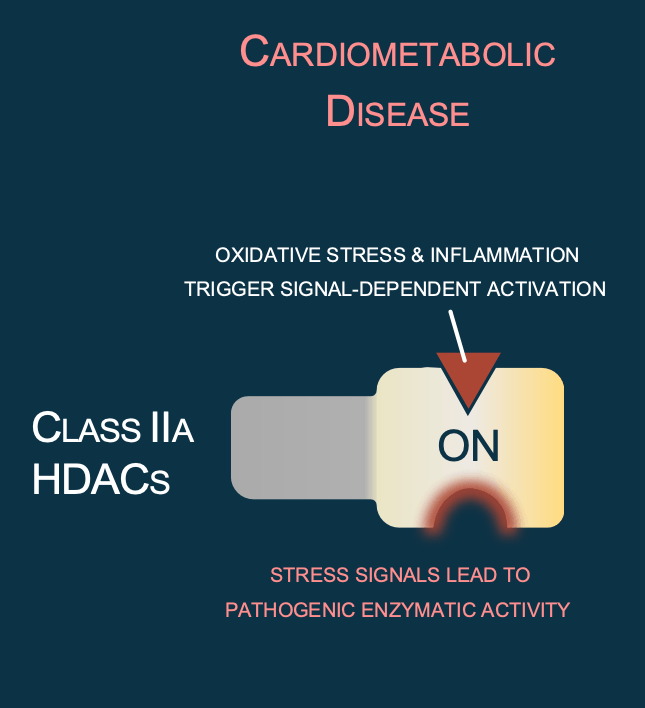
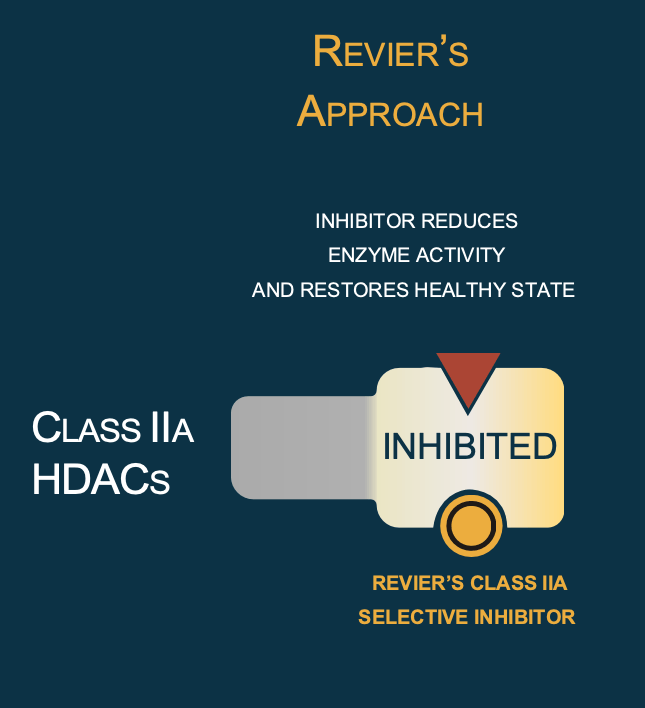
Click the tabs to view the three biological states
In healthy cells, class IIa HDACs have negligible basal enzymatic activity. Their steady-state biological activity is primarily driven by their transcription factor (TF) binding domain, governing cellular differentiation and maintaining normal metabolic balance across the heart and other organs.
In cardiometabolic disease, class IIa HDAC catalytic activity is elevated and drives disease onset and progression. Inherited and acquired cardiometabolic risk factors such as obesity and arterial hypertension can trigger inflammatory and oxidative stress. This leads to stimulation of pathogenic enzyme activity in multiple cell and tissue types, manifesting in cardiometabolic indications including vascular disease and heart failure.
Revier’s orally available selective class IIa HDAC inhibitors are designed to return enzymatic activity toward healthy levels without interfering with the steady-state activities of the TF-binding domain.
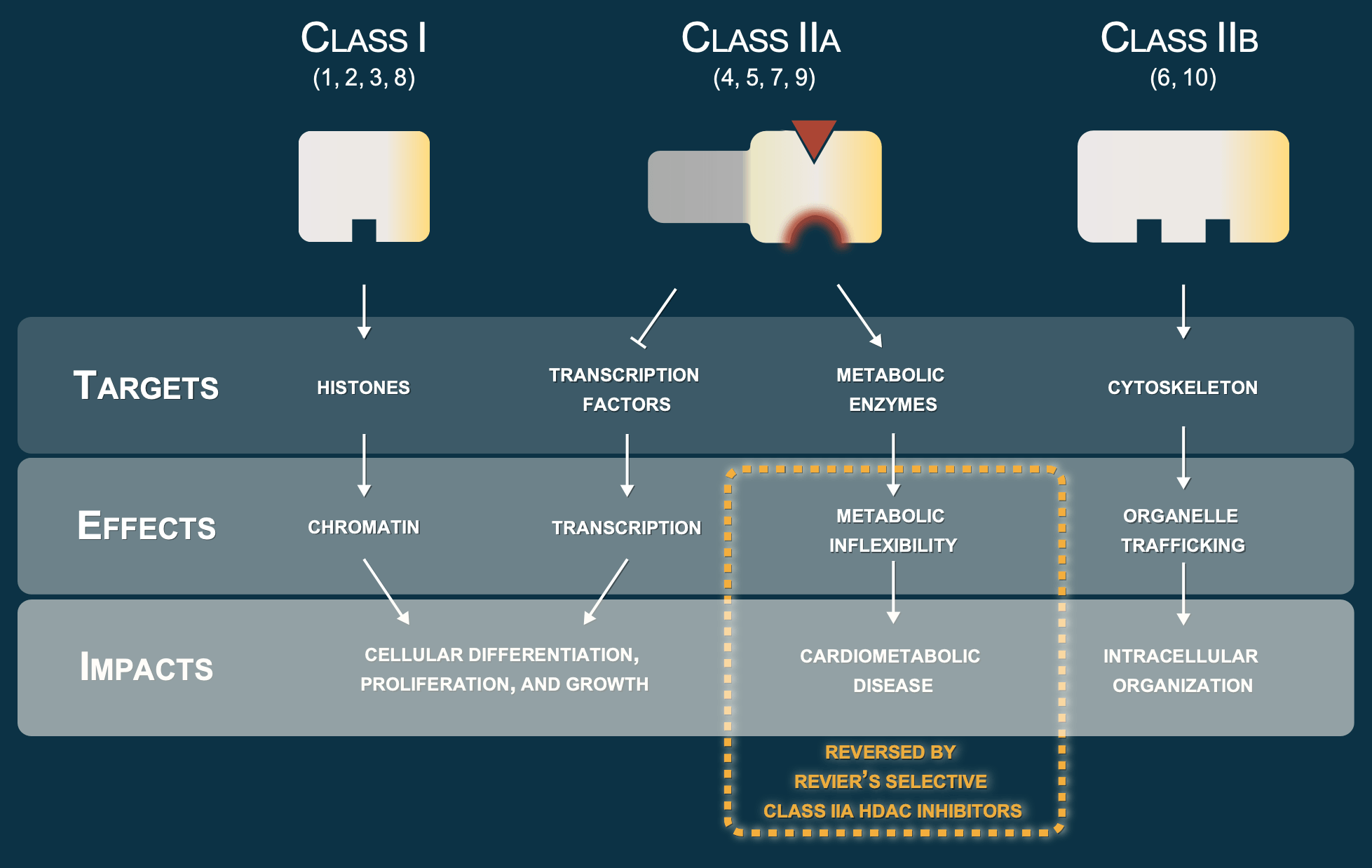
HDAC enzymes control important processes inside cells, but each HDAC class has a distinct role.
Class I HDACs act on histone tails and mainly help regulate chromatin structure and gene expression to control differentiation of cells, while class IIb HDACs act on cytoskeletal proteins to support cellular structure and organization.
Tap on image to enlarge
Class IIa HDACs are different. They have little enzymatic activity in healthy people. Through their non-enzymatic TF-binding domain, they control cell growth in development and disease by interacting with transcription factors. When cardiometabolic stress activates the enzymatic activity of class IIa HDACs, it can alter the utilization of energy substrates, metabolic flux and immune function. Growing evidence links this change to cardiometabolic diseases such as heart failure with preserved ejection fraction (HFpEF) and atherosclerotic cardiovascular disease (ASCVD), highlighting these enzymes as attractive therapeutic targets.
By developing small molecules that selectively and potently engage with class IIa HDAC enzymes, we aim to overcome limitations that have historically challenged HDAC-targeted therapies.
Our small molecules are engineered to:
Selectively inhibit disease-causing class IIa HDAC enzymatic activity
Preserve non-enzymatic functions that support normal cellular health
Avoid canonical HDAC inhibition and minimize associated risks
Restore cardiometabolic function to improve quality of life and long-term patient outcomes
Our approach is grounded in extensive published research and deep in-house expertise in class IIa HDAC biology and cardiometabolic disease.
Circulation Research
Journal of Molecular and Cellular Cardiology
Nature Metabolism, PMID: 31742248
EMBO Molecular Medicine
Journal of Cell Biology
Nature Medicine, PMID: 29227474
EMBO Molecular Medicine
Circulation Research
Molecular and Cellular Biology
The Journal of Clinical Investigation
Cell
BioRxiv
Circulation
Nature
Nature Chemical Biology
EMBO Molecular Medicine
Journal of the American College of Cardiology
Frontiers in Molecular Biosciences
Journal of Molecular and Cellular Cardiology
AI-generated image
Revier is developing a portfolio of oral, first-in-class small molecules that selectively target class IIa HDAC isoforms linked to major cardiovascular and metabolic disorders, with the goal of delivering safe and durable disease‑modifying options for patients.
Our most advanced program is rapidly progressing toward development candidate nomination, paving the way for clinical studies in HFpEF in the near future. In parallel, we are pursuing discovery efforts across additional cardiometabolic indications.
Our team combines deep expertise across cardiovascular biology, translational science, drug discovery, clinical development and business execution. Together, we are pioneering a new class of therapies for patients with cardiometabolic disease.
CO-FOUNDER & CHIEF EXECUTIVE OFFICER
CO-FOUNDER & CHIEF TECHNOLOGY OFFICER
CO-FOUNDER & CHIEF SCIENTIFIC OFFICER
CO-FOUNDER & CHIEF MEDICAL OFFICER
Scientific founder
Revier is supported by a syndicate of life science and private investors with a shared commitment to advancing innovative therapies for patients with serious cardiometabolic diseases.
Our scientific foundation is rooted in pioneering research on class IIa HDAC biology and strengthened through collaborations within the Heidelberg life science ecosystem.
August 28-31, 2026
Attending: Eva van Rooij, Johannes Backs, Matthias Dewenter, Michael Nolan, Norbert Frey
Location: Munich, Germany
September 22-23, 2026
Attending: Michael Nolan
Location: Boston, MA USA
September 24, 2026
Attending: Matthias Dewenter
Location: Heidelberg, Germany
Our lead class IIa HDAC inhibitor selectively targets enzymatic activity to address the underlying drivers of heart failure with preserved ejection fraction (HFpEF). Preclinical studies show our lead inhibitor reverses diastolic dysfunction and restores exercise capacity to healthy levels in vivo.
Our second asset is a class IIa HDAC inhibitor optimized to selectively target disease-driving mechanisms and maximize therapeutic benefit in atherosclerotic cardiovascular disease (ASCVD).
Our earliest-stage drug discovery programs are focused on isoform selectivity within the class IIa HDACs, with the goal of advancing additional first-in-class assets for cardiometabolic diseases and beyond.
CO-FOUNDER & CHIEF EXECUTIVE OFFICER
Eva is a serial entrepreneur bringing extensive experience at the intersection of biotechnology development, drug discovery, and cardiovascular translational research to Revier. Her pioneering work on cardiac microRNAs contributed to the scientific foundation of miRagen Therapeutics, one of the first companies developing microRNA-based medicines for cardiovascular disease, and subsequently to the founding of Phlox Therapeutics. Eva is Professor of Molecular Cardiology at University Medical Center Utrecht and a Group Leader at the Hubrecht Institute, where her research aims to identify signaling pathways that drive cardiac remodeling and repair and to translate these discoveries into new therapeutic strategies.
She holds a Ph.D. in Molecular Biology from Maastricht University.
Mike is an experienced biotechnology executive with more than 20 years of drug discovery and company-building experience. He served as the VP of Biology at Valence Discovery when it was acquired by Recursion. Between 2018 and 2023, he was Entrepreneur-in-Residence at Atlas Venture, where he co-founded Quench Bio and led its biology and early drug discovery efforts, then built industrialized proteomics as a founding-stage team member at Matchpoint. Earlier in his career, he held scientific leadership positions at GSK, Tempero Pharmaceuticals, Ascent Therapeutics and Wyeth, advancing therapeutics across inflammation, immunology, oncology and fertility indications.
He holds a Ph.D. in Pharmacology from the University of Washington.
Matthias is a physician-scientist with extensive experience in translational cardiovascular research. He serves as the Head of the Preclinical In Vivo Model Core at the Institute of Experimental Cardiology, Heidelberg University Hospital, where he has contributed to the discovery and preclinical development of novel experimental approaches for heart failure and cardiometabolic disease over the past decade. His research focuses on the molecular mechanisms underlying heart failure, cardiac metabolism, and cardiometabolic disease, with the goal of translating biological insights into new therapeutic strategies.
He holds an MD in Medicine/Pharmacology from the University of Goettingen.
Norbert is a physician-scientist and clinical cardiologist with extensive experience in cardiovascular medicine and translational research. From 2008 to 2020, he served as Professor and Medical Director at the University Medical Center Schleswig-Holstein (Kiel). Since 2020, he has been Professor and Medical Director of the Department of Cardiology, Angiology and Pneumology at the Heidelberg University Hospital. He is also President-elect of the German Cardiac Society (DGK). His research focuses on the molecular basis of cardiomyopathies and heart failure and on translating these insights into improved therapies for cardiovascular disease. He has initiated and participated in numerous clinical trials.
He holds an MD in Medicine/Pharmacology from the University of Kiel.
Scientific founder
Johannes is a cardiovascular scientist whose discoveries have advanced our understanding of cardiobiology and led to new therapeutic concepts for cardiogenetic and cardiometabolic disease. Over the past two decades, his research has uncovered fundamental mechanisms linking epigenetics, metabolic stress, inflammation to CaM Kinase II and HDAC signaling as causes for cardiac dysfunction. Johannes is the Director of the Institute of Experimental Cardiology at Heidelberg University, professor of the German Centre for Cardiovascular Research (DZHK), Director (interim) of the Helmholtz Institute for Translational AngioCardioScience (HI-TAC) and Spokesperson of the Collaborative Research Center „Molecular Circuits of Heart Disease“ (CRC1550).
He holds an MD in Medicine from Heidelberg University.